
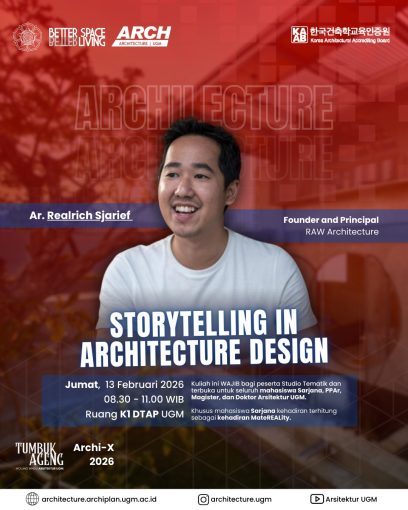
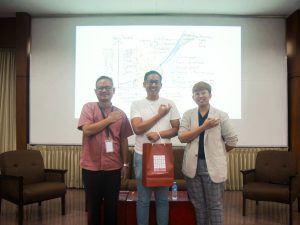
Storytelling is an essential process in architecture. The ability to tell a story (or to communicate effectively) plays a crucial role in determining how successfully designers convey their ideas to clients and to the broader audience of architectural works. Storytelling became the central theme of the ARCHI-X series organized by the Undergraduate Architecture Program, Universitas Gadjah Mada, in early 2026. Following the Writing Workshop held on 2–12 February 2026, the program continued with a guest lecture (Archilecture) featuring Realrich Sjarief, ST, MUDD, IAI, founder of OMAH Library. The lecture, titled “Storytelling in Architecture Design,” took place at Room K1, Department of Architecture and Planning (DTAP), on Friday (13/2).
The session began with a brief review of 12 student works produced during the Writing Workshop. During this session, Realrich expressed his admiration for the architecture of Wisma Kuwera, designed by the late Romo Mangun, which was selected as one of the workshop topics. His interest in the building has led him to revisit it whenever he is in Yogyakarta.
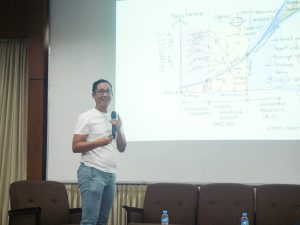
In his presentation on storytelling, Realrich introduced three stages of storytelling through a diagram he specifically sketched for this Archilecture. In the initial stage, people tend to tell stories about material or tangible aspects, characterized by descriptive and experiential narratives. In the next stage, storytelling evolves into a means of influencing others, such as in teaching contexts. This stage is marked by formal (measurable), historical, and activist qualities. In the final stage, storytelling shifts toward a more spiritual realm, aiming to touch the heart through architecture and relate to values of goodness and the cycle of life. Realrich further categorized several of his works according to these stages.
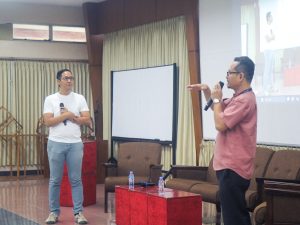
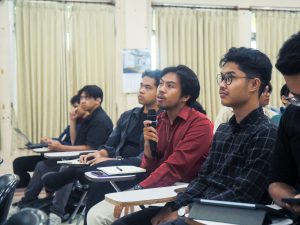
The session continued with a discussion and Q&A with students, both attending in person and online. In this discussion, Realrich shared his experiences in architectural practice, highlighting the importance of psychological aspects that are often overlooked in the design process. He emphasized that understanding clients’ needs requires deep and meaningful dialogue. In this process, the architect’s attitude, empathy, and sincerity serve as a bridge between the client’s aspirations and the values upheld by the designer.
This initiative reflects the program’s commitment to advancing Sustainable Development Goal (SDG) 4: Quality Education, by fostering critical thinking, communication skills, and reflective design approaches among students.




News by Nisrina Amalia Paramanindya
Photos by KMTA Wiswakharman